Please visit Search Engine Land for the full article.


from Search Engine Land: News & Info About SEO, PPC, SEM, Search Engines & Search Marketing http://ift.tt/29cA3v6
via IFTTT


Contrary to popular belief, Snapchat isn’t just for the teen population trying to escape their Facebook-friending parents.
As of May 2015 there were 100M active users daily and over 77% of them are above the age of 18. As well as this, Snapchat is now boasting 8M daily views equaling that of Facebook (who has a much larger user base). When you consider these statistics, it becomes clear that for the most part, Snapchat incorporates most businesses’ ideal client.
The questions I see flying around right now are – What benefit is Snapchat to me as a blogger? How do I use it effectively without wasting my time? How do you find anyone on the platform?
Essentially what people are asking is – How do I use it for business?
So if you haven’t jumped on Snapchat yet I want to share a few cold, hard facts with you before I answer the above.
1. Snapchat is not a scalable platform.
2. For the most part, the way you use Facebook or Instagram or Twitter or Pinterest can not be applied to Snapchat.
3. It’s difficult to measure ROI. Discoverability (the ability for you to find people and for people to find you) is not as simple as other platforms and really has only been opened up in the last few months with apps such as Ghostcodes.
4. You can’t really run ads on Snapchat yet unless you’ve got a lot of financial capital or at least a decent sized marketing spend ($10k is a good round figure to start with).
5. Finally, the user experience isn’t known for being super user friendly – at least initially until you find familiarity with it.
That being said, Snapchat is amazing for building 1:1 relationships.
Yes, this can be time consuming but the return from this can be far more exponential than broadcasting your message elsewhere.
Consider the fact that you can message, call, respond to in-feed snaps, send video, send audio only and easily send photos all from within the app. It’s basically a comprehensive communication tool that can be used no matter what industry you’re in.
So below, I’d like to give you some tips on how you can use the platform effectively for blogging.
I know it’s on trend at the moment to talk about storytelling but the truth is, this is actually what Snapchat is great for. You have a mixture of image, video and editing capabilities that allow you to tell a story any way you like.
The reason storytelling is vital to your brand is because that’s how we as humans have communicated from the beginning of time. A story is compelling and invites the onlooker to not only discover your world but also to engage in it too in a digestible way.
If you create a fun, compelling or informative story make sure you repurpose it elsewhere. Whether it be YouTube, Facebook, Instagram or your blog, don’t let it go to waste.
I’m so passionate about repurposing because I know how busy life gets and repurposing allows you to keep pushing out content and reaching your audience without running yourself into the ground trying to be original and creative every single day.
If you have a new blog post waiting to go out and you’re choosing between titles, consider putting it to your audience and asking them to vote for the best title.
Stringstory often talks about screenshots being the new ‘like’ of Snapchat.
With this in mind, set your audience up and let them know you need some help choosing a title and you need them to snap the one that they like best. Then use the next few snap screens to individually showcase the titles. Change the snap length to 10 seconds to give them the maximum amount of time to read and snap their choice.
Another idea is to create bit.ly links that you ONLY share with your Snapchat followers. This allows you to measure how many are coming to your website and/or blog posts from Snapchat and gives you an idea on the relevancy and return from that audience.
If you sell products or are an ecommerce store I suggest the above bit.ly method also to see your immediate ROI in relation to specific product.
Bit of a mouthful, I know. But basically what this means is to use Snapchat to push people to other platforms if you have something going on there.
I watched Gary Vaynerchuk do this a lot during his #AskGaryVee book launch. He would push people to his Instagram account through Snapchat, ask them to write something that they would only know if they had come from Snapchat and they would have the chance to win a book.
What this does is further cement your community by having them see you and engage with you on multiple platforms. Without going too heavily into it, this just means that further down the track it will be easier to sell to them because they have more buy in.
As cliché and abstract as this sounds, it’s actually imperative that you have fun on the platform. If you don’t, people will see right through it and write you off.
As with any platform, try to avoid being too in-your-face with sales, always give value where possible and engage when time permits so that people know it’s a two way street and not just a broadcasting tool for you.
This is probably one of the most important things you can do on this platform and in my opinion, is what Snapchat is truly designed for.
If you are not willing to engage individually it almost defeats the purpose of being on there in the first place. Because Snapchat is not particularly scalable, you are going to have the most success by interacting with the people that reach out to you.
Personally for me, this has led to ongoing business as well as overseas travel, speaking gigs and most importantly, new friendships.
I’ve reached out to influencers and had responses from them where I know I wouldn’t be able to get that on other platforms because there’s so much more noise. This is good news for those of you looking to guest blog or who have someone in mind to feature a product or engage in influencer marketing.
As with any platform you have to be consistent in order to adequately measure whether it’s working for you. Figure out what consistency looks like for you and try your best to keep to that.
I know a number of people who have thematic days or choose a theme to define the week in order to help them with their constistency. Currently Ahna Hendrix (CEO of ARCH Digital Agency) is doing this and for the past week has been creating content around the word ‘determination.’ She talks, shares quotes and songs and thoughts positioned around her theme and creates a cohesive week of thematic content.
I share this with you to encourage you to do something similar for yourself so that you don’t get too overwhelmed with creating new content all of the time. Overwhelm is a very real problem in the social media space and we want to avoid that by being organised and making it as easy for ourselves as possible.
These 7 suggestions to me, are the keys to the Snapchat kingdom and if you can master them I truly believe you will not only find success within the platform but you will grow to love creating content this way.
My final suggestion is to give it a go. Often times we let overthinking paralyze us when really we could have spent the same amount of energy just trying it in the first place.
Sarah is the CEO + Founder of Eleven Lights Media, a social media agency. If you want to connect you can find her on Facebook, Twitter and Snapchat. She is everywhere (as you might expect) but these are the best ones to connect!
The post 7 Steps to Snapchat Success appeared first on ProBlogger.


Be honest for a moment…
When publication day rolls around, do you have a post ready? Or do you frantically scramble at the last minute to figure out what you’re going to write?
When you’re writing guest posts for other blogs, are your topics carefully coordinated and strategic, or scattered and inconsistent?
And what about your efforts to fuel the growth of your blog?
Have you tried several different tactics, such as webinars, Periscoping, and Facebook ads only to see lackluster results?
If so, your blog is suffering from randomness.
Fortunately, there is a cure.
No matter how good your instincts are as a blogger, real success comes from careful planning, not a series of in-the-moment decisions.
And that means having a content strategy.
It’s the linchpin that makes everything work together. It’s what helps you build momentum to continue to grow over time.
So what exactly is a content strategy?
Demian Farnworth, chief content writer at Copyblogger, defined it this way:
Research from Content Marketing Institute and Marketing Profs shows that those with a documented content strategy consider themselves more effective with their content and social media channels.
But even though the data indicates that a strategy is essential for building a successful blog, the vast majority of bloggers don’t have one. No bueno.
Bloggers have an abundance of choices. They have almost no limit to the number of possible tactics that could move the dial on their blog.
But the paradox of choice is that when you have many options available to you, it becomes difficult to choose between them.
Here are a few of the decisions you face when it comes to growing your blog.
First, there’s the medium. Should you only blog? Podcast? Make videos? How about all three?
Then there’s the format. Should your content be long and detailed like the posts here on Smart Blogger? Or should they be short and pithy like Seth Godin’s posts? Or perhaps you should curate the content of others?
And what about frequency? Should you post daily, weekly, or only when you have something truly epic to say?
Then there’s the equally important task of how you drive traffic to your blog.
Here too you have multiple approaches when it comes to figuring out the right plan for you.
The result of having so many options is always the same. You end up paralyzed, anxious, and wasting time.
As a result, your blogging “plan” resembles something like this:

But imagine your results if your plan looked more like this:

When you compare the two, it’s easy to see which approach will likely yield tangible results, and which will leave you floundering in a sea of randomness.
When I worked my corporate job, our annual business planning was a long, grueling process over the course of four to six weeks. The good news is creating a strategy for your blog doesn’t require the same level of pain.
All you have to do is follow a framework that charts a clear path to get you to your goals.
In his classic book, The 7 Habits of Highly Effective People, Stephen Covey wrote about the importance of getting clear about where you want to go:
In building your content strategy, your first choice should be deciding on your objective.
Specifically, you have to get clear about why your blog exists, by defining your ultimate goal.
Smart bloggers blog for a definitive specific reason. What’s yours?
Here’s an example:
Next, take this “big prize” that you are working toward, and break it down into specific targets you need to achieve to grow your blog along the way. This will help to guide the strategy you create for your content.

Your milestones will vary depending on where you are in your blogging journey. Here are some common ones:
Your strategy may need to adapt as you hit each important milestone, so it’s a good idea to revisit your content plan after you hit each one.
Every decision with your blog must begin with your readers. You’ve got to consider their likes, dislikes, and needs, as well as their dreams, desires, fears, and frustrations.
If you’re tempted to ignore this step, assuming you know everything there is to know about your audience, don’t. This is the glue that makes everything work.
Some common, helpful advice for getting to know your ideal readers well is to develop personas. Here’s how blog and business writing coach Henneke describes the relationship you should have with your ideal reader:
When describing your ideal reader, don’t just think about demographics like age, gender, income, education, and family circumstances. Do you know what he dreams of achieving? And what keeps her awake at 3am?”
(To find out more about getting to know your readers better than they know themselves, go here, here, and here.)
Once you’ve got a strong handle on who your audience is, you can use that information to guide your content strategy.
Your content plan will serve as a “conveyor belt” to help you move your audience along the various steps in the journey that leads you both to your goals.
Here are the typical stages you need to move your audience through:

To effectively move your readers from phase to phase, use the knowledge uncovered in the previous stage to answer the following question:
Because when you think about everything you publish not simply as “content” but as a catalyst for a specific change, your approach to blogging will shift.
Great content transforms your readers. And that transformation should progress both you and your audience toward your respective goals. That’s why every piece of content you publish needs to have a purpose.
To induce this change, you need to know what issues are dominating your readers’ thoughts, as well as what they need to move to the next step with you. This will help you determine what type of content to give them.
Matching the right content to where your audience is on their journey with you is critical to helping you get results.
Here’s an example of what types of content works for the various stages:

And here’s an example of that playing out in the real world.
In this guest post on The Change Blog, international best-selling author Stephen Guise uniquely addressed a common burning pain of his ideal reader: getting in shape. As a result, he was able to turn thousands of strangers into readers.

By offering a free chapter of his book on mini-habits, the strategy he wrote about in his guest post, Stephen was able to convert a good number of those new readers into subscribers for his blog.

Every Tuesday morning when he sends an email to his list, he works to turn those subscribers into loyal fans by continuing to address topics that interest them.
And some of those fans become customers whenever he releases a new book or reminds them of other books and courses he has available that are in line with their needs.

When deciding what content to give your audience, you’ll also have to determine the best format.
There are basic choices such as the medium: i.e., text, audio, or video. But there are tons of other considerations too, including length, use of images, and even if your blog post should be a listicle, case study, or tear jerker.
Before you get overwhelmed, take comfort in knowing there’s a simple way to discover which choices are ideal to help you grow your blog.
Let the data decide for you.
Mining the comments you’ve received on content you’ve already published can give you clues about what your audience is most receptive to.
Andrew Warner at Shade of Info published this long-form post. Based upon the gleeful comments he received, his audience is hungry for more content with the same level of detail.


You could also ask your audience what their preferences are. In this post, Linda Formicelli used a simple survey to figure out if her audience wanted her to branch out into audio and video content.

And in this case study, Andrianes Pinantoan, detailed how Canva used 3rd party data to figure out the ideal post length, type (list post), and even the number of images they should include in every article.
By doing research on their competitors’ most popular posts, using forums to identify new ways to tackle common issues, and capturing insights on what their readers were already sharing, they were able to create a profile of the form their content needed to take if they wanted to grow.

As with the format, the objective of each piece of content plays a role in channel selection. If your goal is engagement with your audience, then publishing on your blog or sending an email to your subscribers is the way to go.
If you are trying to reach a new audience, you’ll need to select a channel that lives outside your blog.
Here’s a way to think of which channels are most appropriate for each stage your audience goes through.

Srini Rao, host of the Unmistakeable Creative podcast, publishes blog posts on Medium as a way to get new listeners.
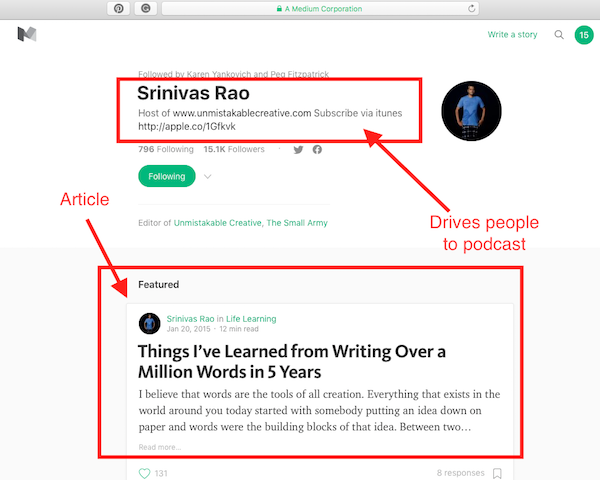
Because creating great content can be so time-consuming, consider publishing different elements into different channels to get as much traction as possible out of the core pieces you produce.
Gary Vaynerchuk swears by this repurposing strategy. From his core content pillars of The #AskGaryVee and Daily Vee shows, he and his team make several pieces of content reach different audiences in different places.

Jay Baer of Convince and Convert does this as well. Three times a week, Jay publishes a three-minute Jay Today video. And each video becomes eight different pieces of content. It’s part of what they call their “atomizing” strategy.

Have you ever met someone, hit it off brilliantly, then failed to stay in contact afterward?
That relationship would have had a chance to develop if one of you had been more intentional about keeping it going.
In growing your blog, you can’t expect your audience to actively build the relationship. It’s up to you to provide consistent communication to maintain the connection with your audience.
The key is to set expectations so they know when to expect to hear from you.
Ben Settle emails his subscribers daily and is very clear in making sure that people considering signing up to his list are aware of how often he will show up in their inbox.

Even if daily contact seems too much (and it probably will be for most bloggers and audiences), it makes sense to email your subscribers more frequently in the beginning.
Many smart bloggers will automatically add new subscribers to a short welcome sequence before falling into a regular schedule of sending their latest blog content.
Brian Clark sends new subscribers to his Unemployable list a series of three emails as a part of a mini-course, and then transitions into weekly emails.

Once into your normal publishing schedule, the ideal frequency for you and your audience will be determined by a variety of factors, including their preferences, and how much time you need to produce quality content.
Your aim should be to email often enough so that your audience remembers you and is happy to hear from you, but not so much that they are overwhelmed with all your messages.
Danny Iny and his team at Mirasee email their audience six days a week. But for those in their audience who feel like six messages are too much, they give them the option to receive fewer messages.


And if you’re unsure about what the right frequency is for you, err on the side of publishing less often, and make sure that when you do post, it is the best content you can possibly write on the topic.
Here’s Jon Morrow’s take on this issue:

Another major consideration is how you will get people beyond your subscribers to see your published content.
There are six common ways to do that – you can use one approach or some combination, but each has its pros and cons.
If you’ve got money to invest, this can consistently bring qualified leads to your blog. Facebook Ads can be complex to setup but very successful once up and running.
If your content ranks for a relevant term, it can bring a steady stream of traffic from people searching for the topic you write about.
Danny Margulies at Freelance to Win writes about how to make money on Upwork, and he gets plenty of search traffic because he ranks #1 for this term.

However, be careful about selecting SEO as your primary traffic generation strategy, especially as a beginner. Despite the obvious appeal of search traffic, it’s not the best approach for everyone. But that doesn’t mean you should ignore it altogether.
Here’s more Jon Morrow advice for effectively incorporating SEO into your content strategy:

If you know how to build relationships and connect with influencers, having them share your work is a great way to get introduced to new audiences.
Publishing your content on sites or platforms with significant built-in audiences is a popular way to get more visibility for what you produce. Two common approaches for this strategy are writing guest posts and contributing to 3rd party sites like Slideshare.
When you have a critical mass of people in your audience, who are also sharers, they can serve as a valuable army, quickly disseminating the word about your content.
Here’s how Smart Blogger encourages their engaged readers to share their posts:

Social platforms are designed for sharing and connecting. If you establish a following where your audience hangs out, it can be an excellent way to reach new people and get them back to your blog.
About Meditation uses Instagram to find new readers. Here’s how they strategically use individual posts to get people back to their website:
Here’s the post:

Here’s the call-to-action:

And here’s the link in the bio that leads readers to a landing page on their website:

The last component of your content strategy often seems like a minor detail, but not giving proper attention to this essential element can mean the difference between reaching your goals or not.
It’s all about conversion. Specifically, the content elements that make it clear what next action you want your audience to take, and making it easy for them to do so.
For instance, let’s say your ideal reader comes across a piece of your content on Twitter. They get to your website, read the content, and love it. Once they’re done, they say “that was great” and off they go, never to be seen again.
You did all the hard work to get your ideal reader to your site, but you didn’t have content in place to close the deal. Shame.
To prevent this unfortunate occurrence, make decisions in advance about what specific content you need to convert your audience to the next step in your continuum.
Here are some examples of the conversion choices you could make in each of your audience stages.

Here’s how Happify uses relevant hashtags to increase discoverability on Instagram.

To turn readers into subscribers, Primility uses an exit intent pop-up box that appears after someone finishes reading a blog post.

To turn subscribers into loyal fans, Marie Forleo encourages her audience to leave comments on her videos and gives explicit instructions on how to do it.

And to help convert loyal and engaged fans into customers, I include a money-back guarantee on my coaching sales page.

In each instance, the bloggers make it clear and easy for their audience to take the next desired step.
It’s time to admit it.
You invest too much time and energy in your blog to accept a ho-hum response.
But the truth is, randomness is killing your chances of success.
Without a coherent strategy for turning strangers into subscribers (and maybe even customers too), you’ll burn out before reaching your destination.
You don’t have to create a complicated plan—you just need to work out what content will move people from one stage to the next.
So, give your blog a simple content strategy and start getting real results.
Your blog deserves it.
Your audience deserves it.
And you sure as heck deserve it too.

